the fresh cut flower of the month club

Past Newsletters

Vol 5 No 2

Key Ingredient in Love Potions

Endless Flowers has selected yet another vibrant display for you in honor of St. Valentine's Day intricate flowers whose shapes and fragrances imply a sensual ambience. Over the ages, orchids have been reputed to have magical powers, and if you read the latest research about the connections between mind and body, the ancients could be right! So what have you got to lose try placing an orchid spray under your pillow to inspire dreams of your future Love. Or, add a potion of orchids to your Valentine's drink, and they may become hopelessly infatuated!

Your Dendrobium (den-DRO-bee-um) orchids were grown in Thailand where there are many hybrid and wild orchid species. Dendrobium is a large genus of over 1,000 species. Orchids prefer a cool place - if it's too warm, the buds will fall off before blooming. Israeli Ruscus, the greens accompanying your orchids, are grown in California, and they will try very hard to outlast your orchids!

Orchids grow under many conditions cool, warm, shade, and full sun, so knowing each orchid's natural habitat is essential to understanding how to care for the plant. According to Kauai Orchids, you can find these lovely and hearty flora growing naturally in India, Sri Lanka, Japan, the Philippines, Malaysia, Indonesia, New Guinea, Australia, the Pacific Islands, and New Zealand!

In general, orchids bloom in alternating sequences and under the proper conditions; they take quite a long time to wither. In fact, the last time we sent out similar hybrid orchids, we had several customers call to tell us that theirs had lasted more than 3 weeks! They must have had excellent care, and perhaps the location of the vase was just right to sustain them. For any cut flower to last three weeks is very unusual! On the other end of the spectrum, some wild orchid species bloom and wither all at once needless to say we won't be sending you those!

Greek Aphrodisiac

We can trace orchids back to the Early Greeks who regarded their delicately constructed blossoms as an icon representing virility, beauty and love.

Many people are under the false impression that orchids are very fragile and that they are all very similar, but orchids can be grown
in almost all possible environments, and no plant family is more diverse. Actually, the orchid family is the largest plant family we know about, and they grow wild on every continent except Antarctica. (No surprise to us does anything grow there beside algae?)

Orchids have some unbelievably unique characteristics. The mere fact that their roots can live on air is enough to make us wonder how they can sustain themselves. Their roots are actually quite different from those of any other plants. A special sponge-like layer of tissue called "velamen" completely covers each root. This special sheathing acts as a moisture-collecting device while protecting the roots from direct sunlight. Wild orchids often find bizarre places to grow. It's not uncommon to find them in the crevices of rocks on the side of a cliff!

About 25,000 Species!

This family is amazingly diverse from the thimble-sized Mystacidium Caffrum to the 20-foot-tall Renanthera Storei. Some orchids produce blossoms no larger than a mosquito, while others are as large as a 12" dinner plate. Our Twenty First Century propagation meth-ods and hybridizing trends are offering us more choices than ever before. The many species have different shapes, forms and growth habits. Some yield large flowers of bright hues, while others have little flowers of softer tones. They may flower singly or in small groups of two or three per stem. Some will bloom in a big cluster or a branch, yet others bend down in a flowing cluster. Their scents also run a wide gamut, ranging from those without any smell, to a soft and subtle scent, and to a more full-bodied and pungent fragrance. No wonder people grow orchidsfor a hobby they are so fascinating!

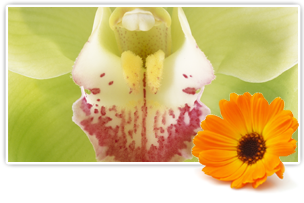
Cymbidium orchids are very popular these days - they offer a tremendous floral display. Among the larg-est of orchids, their tall spikes have from ten to twenty blooms, rang-ing from three to six inches and they last from one to three months when planted.

Native to the foot-hills of the Himalayas, they are accustomed to cool conditions and even elevations above 5,000 feet. They grow naturally at fairly high altitudes in many areas of the world China, India, Thailand, Burma, Taiwan, and parts of Australia.

How To Grow Orchids

WHERE
Orchids are best kept outdoors from May to September, but bring them in before the danger of frost. Shelter them from hot sun and from the rain as well, since you need to control the watering. During the winter, a cool room is the best spot for your orchids. If the room is too warm, the flower buds may drop off and you will have to wait another year to see the results of your labor!

HUMIDITY
All orchids need humidity so put your pots on a stand or tray so they won't have wet feet, and then put the stand and pot in a larger container with pebbles and water. In the hot summer weather it's a good idea to mist your plants every day, but not in the winter.

TEMPERATURE
In summer the plants will tolerate tempera-tures up to about 85ºF (30ºC) and in winter they are happiest with a night temperature of 5OºF (1OºC).

WATER
The plants require quite a lot of water in summer, roughly about a pint a week and in exceptionally hot weather even two pints twice a week (providing the plants are in open bark which will drain immediately). In winter they need much less - about a half a pint every week to 10 days. The large amount of water is necessary in the summer to main-tain very large pseudobulbs and to help with new growth.

FEEDING
These plants are quite hungry and need to be fed all the year round. They should be fed every week to ten days. On the fourth week hold the food and give them plain water to avoid any build up of undesirable chemicals around the roots.

The plants seem to thrive on foliar feeding, and if you are using this method, both sides of all leaves need to be sprayed. Any suitable half strength feed will do, or special orchid food from nurseries and garden centers. Your orchids will benefit more by giving them a higher nitrogen feed early in Spring to help with the growth of new pseudobulbs. By giving a food such as Tomarite or Phostrogen from late June or beginning of July, you will help to ensure that flower spikes are formed. These usually peep through sometime in August or September.

Standard orchids can become very large and take up lots of room, but they are very beau-tiful and their flowers last for many weeks even when cut. The plants are well worth a little tender loving care. If you have tight quarters, miniature orchids are now available, and both kinds of plants can be divided to provide new plants.

POTTING
This is usually done in the spring after blooming, usually every two years or when the potting medium decomposes. Shake all the old potting mix off the roots, dividing the plant if desired. Divisions of green bulbs with leaves must have 3 to 4 bulbs minimum to bloom. Bulbs without leaves are called backbulbs, and need special care to grow.

Pick a potting mix that will hold moisture well... a medium-grade fir bark with peat moss and perlite is a common mix. Select a pot that will allow for at least 2 to 3 years of pseudobulb growth before crowding the pot. Place the active growing bulb(s) of the division farthest from the side of the pot. Spread the roots over a cone of the mix in the bottom of the pot, and fill the pot with medium, working it among the roots, tamping firmly. The junction of roots and pseudobulbs should be about H to 1 below the top of the mix. Keep shaded, drier at roots but humid, until new roots grow.

note: Backbulbs may be left on the division to add strength, or removed to propagate. Take single backbulbs, and bury halfway in a bark or peat/sand mix. Keep shaded and warm until new growth sprouts, and pot as above. It may take up to three years to produce a blooming-size plant from this method.

Are orchids hard to grow?

No more difficult than many popular flowering plants- if you grow other ornamental plants either in the garden or indoors, you can grow orchids. Once a hobby for the wealthy, orchids are now reasonably priced because of modern reproductive methods. A little word for the wise- the hardest thing about orchids is to not become addicted. Trying to own one orchid is like trying to eat one potato chip!

Should orchids be protected from drafts?

No. As a matter of fact, orchids require moving air. They do best where there is a steady, moist breeze. However, if grown indoors, blooming plants should be positioned away from air-conditioning or hot-air vents.

Are most orchids fragrant?

Some are so powerfully scented they will perfume an entire greenhouse or living room. A few orchid fragrances defy description, while others mimic familiar aromas- raspberry, coconut, lilacs and citrus. Others have no scent, but rely on shape and color to attract insects or birds for pollination, thereby continuing the life cycle of the species.

Are orchids short-lived?

Most are long-lived. In fact, some species are virtually immortal, given the proper attention. Divisions or propagations of orchids discovered in the 19th century are still growing and flowering today.

How often do orchids bloom and how long do orchid blooms last?

Some bloom once a year, others bloom several times a year, and some even bloom continuously. Blooms of hybrids of the genus "Cattleya" may last from one to four weeks on the plant. Those of the genus "Phalaenopsis" commonly last from one to four months.

Is conservation of orchids an important issue?

Absolutely! Sadly, orchid species are becoming extinct faster than they can be described and classified. Threats to orchids originate primarily from loss of habitat and collecting. The American Orchid Society (AOS) advocates the purchase of only artificially propagated orchids, either from meristems or seeds, which will help discourage the collecting of orchid species at home and abroad. The AOS also encourages orchid lovers to pollinate orchid species already in their collections and to share the seedlings with their fellow orchidists. For more information about this serious topic, and to learn how to get involved and to support conservation efforts, visit www.orchidweb.org or email the AOS at TheAOS@compuserve.com.

c&h internationals logo since 1994
Since 1994
Home
Join our Club
Gift Memberships
Renewals
More Information
Featured Arrangement
Past Newsletters
Testimonials
Other Gift Ideas
Corporate Gifts
Wedding Gifts
Arrangement Tips
Flower Club FAQ
Flower Care
Resources
Print a Gift Card
Send a Virtual Bouquet
Refer a Friend
Send a Hint
E-Promos
Contact Us
Link to Us

1 - 800 - 625 - 8238
(Outside US call: 949-206-1904)
P.O. Box 1627, Lake Forest, CA 92609